
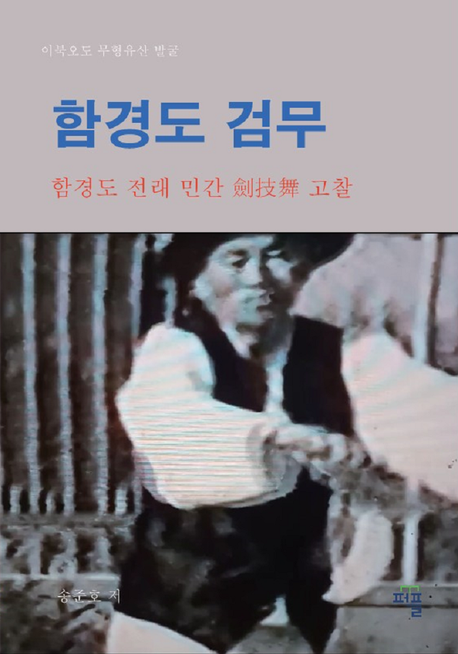
The Korea Subak Association and the World Subak Federation have introduced rare black-and-white archival footage documenting a traditional Hamgyeong-style sword dance preserved within the Korean diaspora community.
The footage, approximately one minute in length, presents movement characteristics distinct from later court-oriented Korean sword dances. Unlike the refined and ceremonial sword dances historically associated with female performers and entertainers during the late Joseon Dynasty, the Hamgyeong-style form displays large-scale spatial movement, forceful stepping patterns, and masculine bodily dynamics.
Researchers involved in the archival project describe the material as an important surviving trace of northern Korean body culture traditions.
According to the research team, the dance does not directly demonstrate combat or sparring structures associated with martial arts. However, the expansive movement patterns, grounded stepping methods, and combative bodily expression may preserve embodied characteristics connected to traditional northern Korean physical culture.
The project also references historical writings from Haedongjukji, authored by Choe Yeong-nyeon during the 1920s. In the text, Choe explained that “Sugisung,” associated with Subak hand techniques, originated from sword-use traditions. Researchers emphasize that this historical observation does not establish direct equivalence between sword dance and martial technique, but rather suggests a historical awareness of movement relationships between armed and unarmed traditions.
The Korea Subak Association states that the archival initiative forms part of a broader effort to study northern Korean body culture through comparative analysis of Subak, Subak dance, Hamgyeong sword dance, folk performance traditions, stone-fighting customs, and regional wrestling practices.
The organization has recently expanded its international academic and educational activities through global archiving platforms including MERLOT, Zenodo, and KOCW. The federation describes these efforts as part of a long-term strategy to preserve endangered Korean intangible body culture traditions within an international educational and heritage framework.
Researchers further noted that the Hamgyeong sword dance material should not be interpreted simply as a martial art reconstruction, but rather as a rare example of embodied cultural memory preserved through movement traditions among displaced northern Korean communities after the division of the Korean Peninsula.
Paper Published (Author Song Jun-ho): A Review of Hamgyeong-do Civilian Sword Dance Movements
https://papers.ssrn.com/sol3/papers.cfm?abstract_id=4613649
Published by Kyobo Book Centre (Author Song Jun-ho): https://product.kyobobook.co.kr/detail/S000211554604
“This archival project and its significance were recently featured in the South Korean cultural press (See: Our Culture News Article).”
https://koya-culture.com/mobile/article.html?no=151503
http://www.youtube.com/@WSFSubak
https://www.facebook.com/groups/956501063419496?locale=ko_KR
© 2026, 편집부. All rights reserved. 모든 콘텐츠(기사)에 대한 무단 전재ㆍ복사ㆍ배포 등을 금합니다.


