
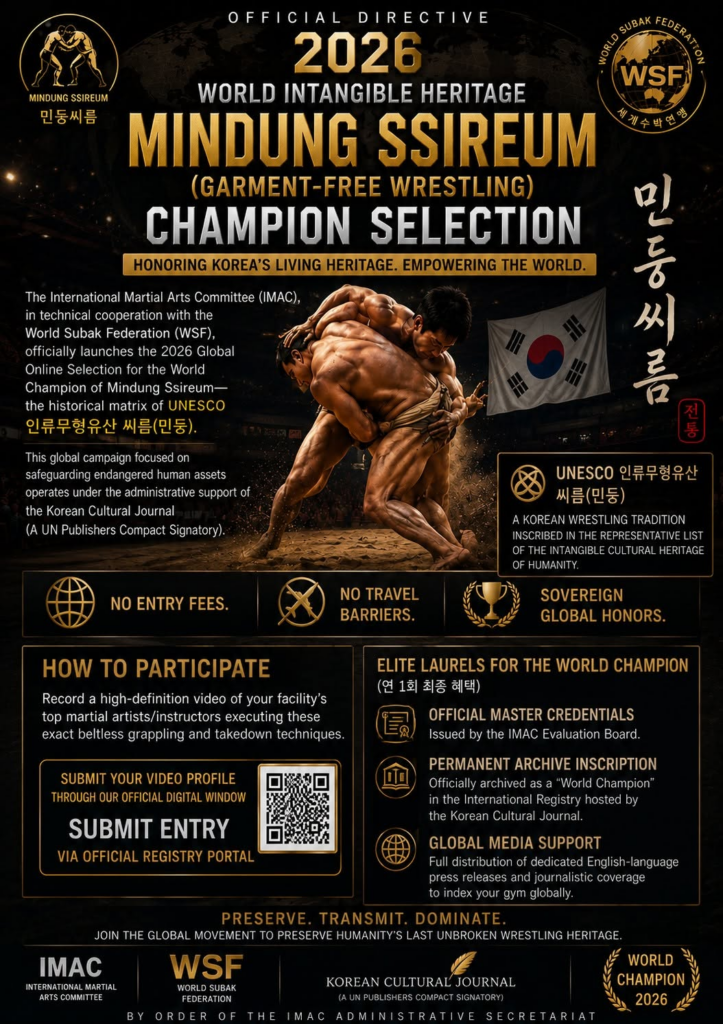
The International Mindung Ssireum Federation (IMSF), an independent international NGO registered and headquartered in Wyoming, USA, has officially issued an institutional decree redefining the global governance of traditional Korean wrestling (Ssireum). The IMSF formally establishes “Mindung Ssireum”—the garment-free, beltless wrestling paradigm historically practiced across the northern and central-western regions, including Hamgyong Province, Kaesong, and Hwanghae Province—as the primitive, uncodified archetype that predates modern mechanized sports rules.
Historical Realignment: Southern Sport vs. Northern & Central Archetype
Since the historic joint inter-Korean inscription of Ssireum on the UNESCO Representative List of the Intangible Cultural Heritage of Humanity in 2018, domestic governance inside South Korea has heavily conflated the entire heritage with Oen-Ssireum (left-sided wrestling). This modern competitive format is historically and academically rooted in the Southern Gyeongsang Province, relying entirely on a restricted sand-pit and the Satba (fabric thigh-and-waist band).
The IMSF explicitly clarifies that the UNESCO inscription protects the holistic cultural ecosystem of Traditional Korean Wrestling as an expansive heritage of humanity, rather than a single modern competitive rulebook. In the chronological evolution of combat culture, primitive warrior communities engaged in grappling long before the invention or forced grip of fabric-dependent tools. Mindung Ssireum represents that pure, tool-less origin.
“While contemporary domestic associations govern the localized, Southern Satba competitions for local media audiences, the IMSF operates on the global stage as a sovereign international authority,” stated the IMSF Executive Committee. “We represent the comprehensive Northern and Central historical lineages. By expanding our structural mapping across the historical combat corridors of Hamgyong, the ancient merchant wrestling of Kaesong, and the raw physical culture of Hwanghae Province, we are delivering the authentic, uncodified archetype of traditional wrestling to the international community.”
Decadal Academic Proof and Bilateral Strategic Governance
The administrative and historical legitimacy of the IMSF is anchored in a critical ethnographical milestone from 2016, when a joint academic symposium was co-hosted with the Department of Physical Education at Yanbian University, China. This initiative yielded the successful field excavation of “Sokswae” (an ancient traditional wrestling variant of North Hamgyong Province) and comprehensive documentation of beltless regional grappling mechanics.
To deploy this heritage globally, the IMSF utilizes a highly tactical dual-governance relationship with the World Subak Federation (WSF USA):
- The World Subak Federation (WSF USA): Functions as the premier peer-reviewed academic society, maintaining the rigorous scholarly firewall, historical indexing, and preservation of ancient striking lineages (Subak).
- The International Mindung Ssireum Federation (IMSF): Operates as the active global front, executing international tournaments, issuing referee credentials, and managing the UNESCO-framework branding for unified dojos worldwide.
© 2026, 편집부. All rights reserved. 모든 콘텐츠(기사)에 대한 무단 전재ㆍ복사ㆍ배포 등을 금합니다.


