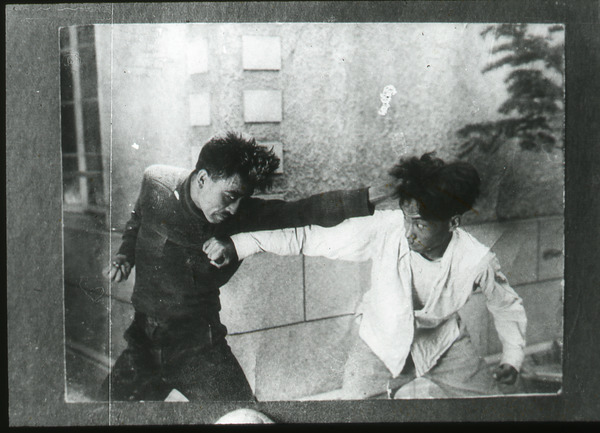
Source: Korean Movie Datebase
Abstract
This study examines possible relationships between colonial-era Korean cinema, anti-colonial historical networks, and Korean martial body culture through comparative analysis of the 1926 film Nongjungjo, directed by Lee Gyu-seol, and visual materials associated with Kim Won-bo.
Particular attention is given to a fighting scene in Nongjungjo depicting close-range combat mechanics involving frontal body control, upper-body destabilization, and rear-hand striking motions. These structures are compared with movement characteristics documented in later Subak-related materials associated with Kim Won-bo and subsequent Korean martial transmission traditions.
The study does not argue that the film directly depicts “Subak” in a formal or definitive sense. Rather, it proposes that the film may preserve visual evidence of broader Korean understandings of close-range fighting, body manipulation, and combat movement during the Japanese colonial era.
Additionally, the paper explores the historical relationship between Kim Won-bo, film director Lee Gyu-seol, and nationalist filmmaker Na Woon-gyu, arguing that colonial-era Korean cinema and martial body culture may have existed within overlapping anti-colonial cultural networks.
Keywords: Subak, Kim Won-bo, Na Woon-gyu, Lee Gyu-seol, colonial Korea, Korean cinema, martial body culture, anti-colonial movement, Korean martial arts, visual anthropology
1. Introduction
The study of Korean martial traditions during the Japanese colonial era has often focused on military resistance, oral transmission, or postwar reconstruction. Comparatively little attention has been given to colonial-era Korean cinema as a possible visual archive of Korean body culture and combat perception.
This paper examines a combat scene from the 1926 Korean film Nongjungjo, directed by Lee Gyu-seol and featuring Na Woon-gyu, one of the most influential figures in early Korean nationalist cinema.
The analysis compares the fighting structures depicted in the film with movement characteristics documented in Kim Won-bo-related Subak materials and later Korean martial transmission traditions.
Rather than claiming direct equivalence between cinematic representation and formal martial systems, this study argues that colonial-era Korean film may preserve valuable evidence concerning how Koreans of the period visually understood close-range combat and body mechanics.
2. Historical Context: Kim Won-bo, Na Woon-gyu, and Lee Gyu-seol
Kim Won-bo participated in the 1919 Korean independence movement and reportedly served a prison sentence during the Japanese colonial period.
Na Woon-gyu, director of the landmark nationalist film Arirang (1926), was likewise associated with anti-colonial activity and reportedly fled Japanese police surveillance connected to independence-related suspicion during the same historical period.
Lee Gyu-seol, director of Nongjungjo, worked within the colonial Korean film industry environment associated with Busan Kinema and overlapping cinematic circles connected to Na Woon-gyu.
Later visual documentation associated with Kim Won-bo was reportedly filmed by Lee Gyu-seol.
Although direct organizational or personal collaboration between these figures cannot presently be conclusively established, the historical overlap suggests that anti-colonial activism, Korean cinema, and martial body culture may have existed within interconnected cultural environments during the colonial era.
3. Analysis of the Nongjungjo Fighting Scene
3.1 Structural Characteristics
A surviving image from Nongjungjo depicts two individuals engaged in close-range combat.
The scene includes several notable movement structures:
- frontal upper-body engagement
- one-handed control of the opponent’s head or collar area
- simultaneous preparation for rear-hand striking
- rotational body positioning
- compressed fighting distance
- forward body pressure
These characteristics suggest a practical close-range combat structure rather than a stylized long-distance striking exchange.
3.2 Comparison with Kim Won-bo-Related Subak Materials
Movement patterns documented in Kim Won-bo-related Subak materials include:
- front-hand interception and control
- upper-body destabilization
- pushing mechanics
- rotational force usage
- follow-up striking actions
- close-range body pressure
The structural similarities between these materials and the Nongjungjo scene are visually notable.
Particularly significant is the apparent combination of:
- one-arm opponent control
- simultaneous rear-hand striking preparation
This movement structure resembles tactical patterns preserved within later Subak transmission traditions.
However, the present study does not claim that the Nongjungjo scene directly depicts formal “Subak” training.
Rather, the similarities may indicate broader continuity within Korean combat movement culture and colonial-era perceptions of practical fighting mechanics.
4. Colonial Korean Cinema as Martial Body Archive
One of the most important implications of this study is the possibility that colonial-era Korean cinema may preserve visual traces of Korean martial body culture.
During the 1920s, Korean cinema had not yet fully adopted modern choreographed combat systems derived from later commercial action cinema traditions.
As a result, early Korean film representations of fighting may have reflected:
- contemporary street-fighting perceptions
- folk combat traditions
- practical body mechanics
- local physical culture concepts
The Nongjungjo scene therefore possesses potential value not merely as cinematic performance, but as evidence of colonial-era Korean understandings of combat posture, body control, and striking structure.
5. Martial Body Culture and Anti-Colonial Context
The relationship between anti-colonial experience and martial body culture constitutes another important dimension of this study.
Kim Won-bo and Na Woon-gyu belonged to the same historical generation shaped by:
- Japanese colonial repression
- nationalist resistance
- imprisonment and surveillance
- cultural survival movements
Within such an environment, physical culture, cinematic representation, and nationalist consciousness may have intersected more closely than previously recognized.
The surviving visual materials associated with Kim Won-bo and colonial Korean cinema may therefore be interpreted as part of a broader anti-colonial Korean body culture archive.
6. Comparative Research Potential
The comparison between Nongjungjo and Kim Won-bo-related materials suggests broader possibilities for interdisciplinary research involving:
- colonial-era Korean cinema
- martial movement analysis
- visual anthropology
- oral testimony
- traditional Korean combat systems
- anti-colonial cultural history
Future comparative study involving:
- Kim Won-bo footage
- Joseon Uiyongdae training materials
- colonial-era Korean wrestling footage
- early Korean films
- surviving Subak traditions
may contribute significantly to reconstruction of Korean martial body culture during the early twentieth century.
7. Conclusion
The 1926 film Nongjungjo and Kim Won-bo-related Subak materials present meaningful structural similarities in their depiction of close-range combat mechanics.
Although definitive identification of the film scene as “Subak” cannot presently be established, the visual comparison suggests the existence of recurring Korean combat movement structures during the colonial period.
The historical overlap between Kim Won-bo, Na Woon-gyu, and Lee Gyu-seol further indicates that anti-colonial activism, early Korean cinema, and martial body culture may have existed within interconnected cultural networks.
This study argues that colonial-era Korean cinema should be considered an important visual source for the study of Korean martial body culture, physical movement systems, and anti-colonial cultural history.
© 2026, 편집부. All rights reserved. 모든 콘텐츠(기사)에 대한 무단 전재ㆍ복사ㆍ배포 등을 금합니다.